EMI Online Workshop: Innovative Pedagogy for EMI and Model Lessons
【NSYSU X AIT】English Language Specialist Program
EMI Online Workshop Junior I: Innovative Pedagogy for EMI and Model Lessons
•Date: 10, June 2022, Friday, 14:00-17:00
•Specialist: Dr. Karen Barto
The first step of developing innovative pedagogies for EMI courses might be reflecting on the teacher’s own past learning experience.
At the beginning of this session, Karen Barto launched group discussions for professors to recall the transmission models with which they had been educated and compare them with their own teaching approaches.
Dr. Cheng-chau Chiu shared his student experience of a Quantum Mechanics course in which they only discussed the exercises done at home,
while Dr. Ke-li Tsai said most undergraduate courses were traditional lectures, and as for Lab courses, they simply verified what they learned by following the instructions to conduct experiments.
Karen Barto also identified the common unnaturalness, weirdness, and awkwardness of local students to communicate in a non-native language,
and that is exactly what the topic of this session, innovative pedagogies, are devised to deal with.
Serving as a model lesson itself, this session made manifest to participants the realistic challenges of an EMI class and possible strategies with which to encounter them.
※Transmission Model and Innovative Pedagogies:
Innovation in transmission model does not entail creating something new, but is more about updating the aspects of the transmission move. Approaches worthy of consideration are:
1. Focusing on student engagement and active learning─To demonstrate how to check students’ degree of attention, curiosity, interest, optimism, and passion,
Karen Barto asked participants to share their definition of “student engagement” in Chinese. The same tactic also applies to checking foreign students’ understanding.
Equally important is to discover different engaging students, especially those engaged quietly;
to maintain active learning, the instructor does not stop lecturing but engages students through continual activities such as asking simpler and gradually harder questions,
asking them to read the slides, and have them follow scaffolds
(like partially complete graphic organizers and slides, charts for them to identify respectively what they already know, want to know, learn after class, and want to learn further, and activities to share the main ideas of the lesson.)
2. Learning through production─As an output-oriented pedagogical approach,
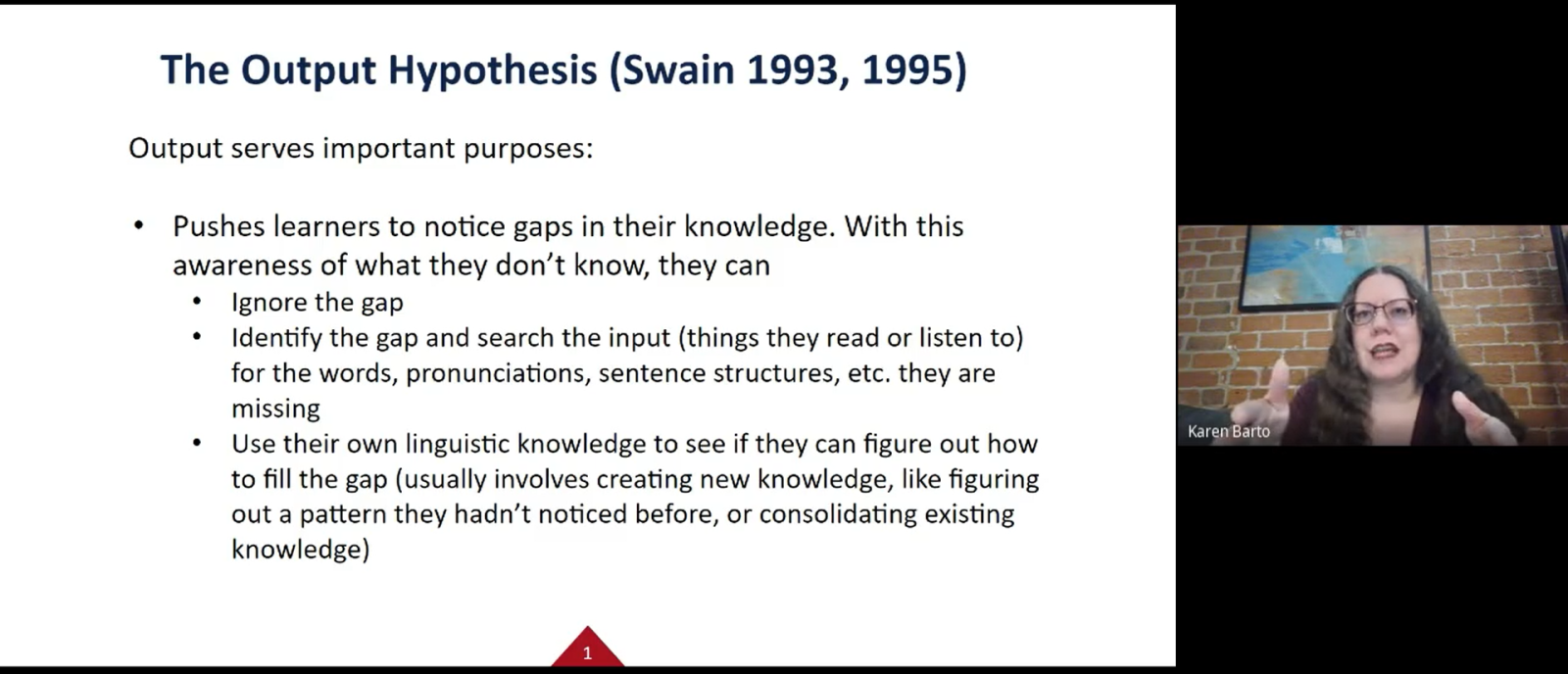
it allows students to learn actively in the process of production during which they would come to be aware of their cognitive stages and recognize the gaps regard to the target knowledge.
Through repeated practice, they would be able to develop new knowledge to fill the gaps and more fluency in expressing what seems to be understood but could not be explained.
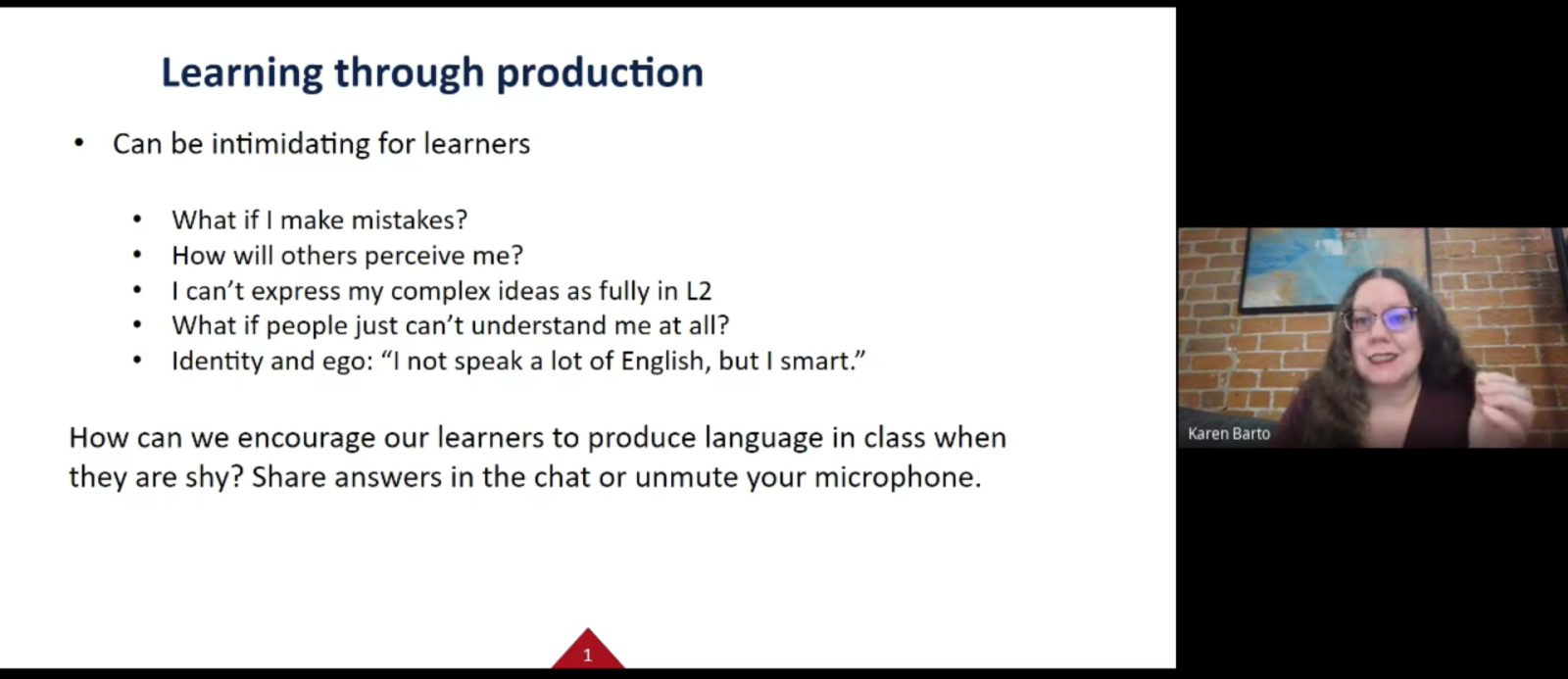
However, since learning through production is highly experimental and mistakes are necessarily frequent and abundant,
learners are more likely to be worried and frustrated by failures. It can be intimidating to those who are not so confident and shy.
Karen Barto invited fellow participants to share their opinions on how to handle such situations.
Professors enumerated a series of ideas in the chat box, including letting students write down thoughts before sharing,
discuss with peers before presenting, type in the message box, answer anonymously, preparing incentives, providing room for preparation, giving feedback and encouragement, and so on.
In general, to reassure students, Karen Barto suggested that teachers set the tone that they allow themselves mistakes, respect students’ efforts, and reinforce well-done performance with kind responses.
3. Three types of interaction─Different kinds of production are generated in different contexts of interaction.
Activities or practices of the three types, student-instructor, student-student, and student-content interactions,
are particularly helpful to facilitate community building and promote the achievement of learning objectives.
Within student-instructor interaction, feedback from instructors can bolster student learning and increase student engagement,
while feedback from students can foster instructors’ understanding of student learning and needs to improve instruction;
the promotion of student-student interaction can enhance student engagement through community building, collaborative learning, and peer review;
creating contexts of student-content interaction with written, video, and audio materials can encourage active learning and inspire student engagement.
Participants also brainstorm with each other to come up with some activities or practices of interaction of the three types,
including using Kahoot to check student comprehension, serving as the consultant of learning projects, arranging competitions, communicating with students through email, etc..
4. Tranlanguaging─Karen Barto applied jigsaw reading for groups responsible for reading different sessions of the Wikipedia translanguaging page.
The outcome of the cooperation between all groups and Karen Barto: “Translanguaging can refer to (1) a pedagogical process of utilizing more than one language within a classroom lesson,
(2) or can be used to describe the way bilinguals use their linguistic resources to make sense of and interact with the world around them;
Translanguaging is based on the idea that bilinguals are not two monolinguals in one;
although those opposed to translanguaging think it produces difficulty in communicating with one another,
misunderstanding may be resolved quickly with other means, and it should not be expected that L2 speaker should achieve native-speaker competence;
postmodernists describe the internal linguistic system as “idiolect,”
and they believe “the internal linguistic system is considered unitary and encompasses all grammatical and lexical systems”;
varieties of English called International Englishes are used widely worldwide.
They are varieties of English spoken by multilingual users around the world, not those “native speaker” varieties of the USA, the UK, Canada, Australia and New Zealand.
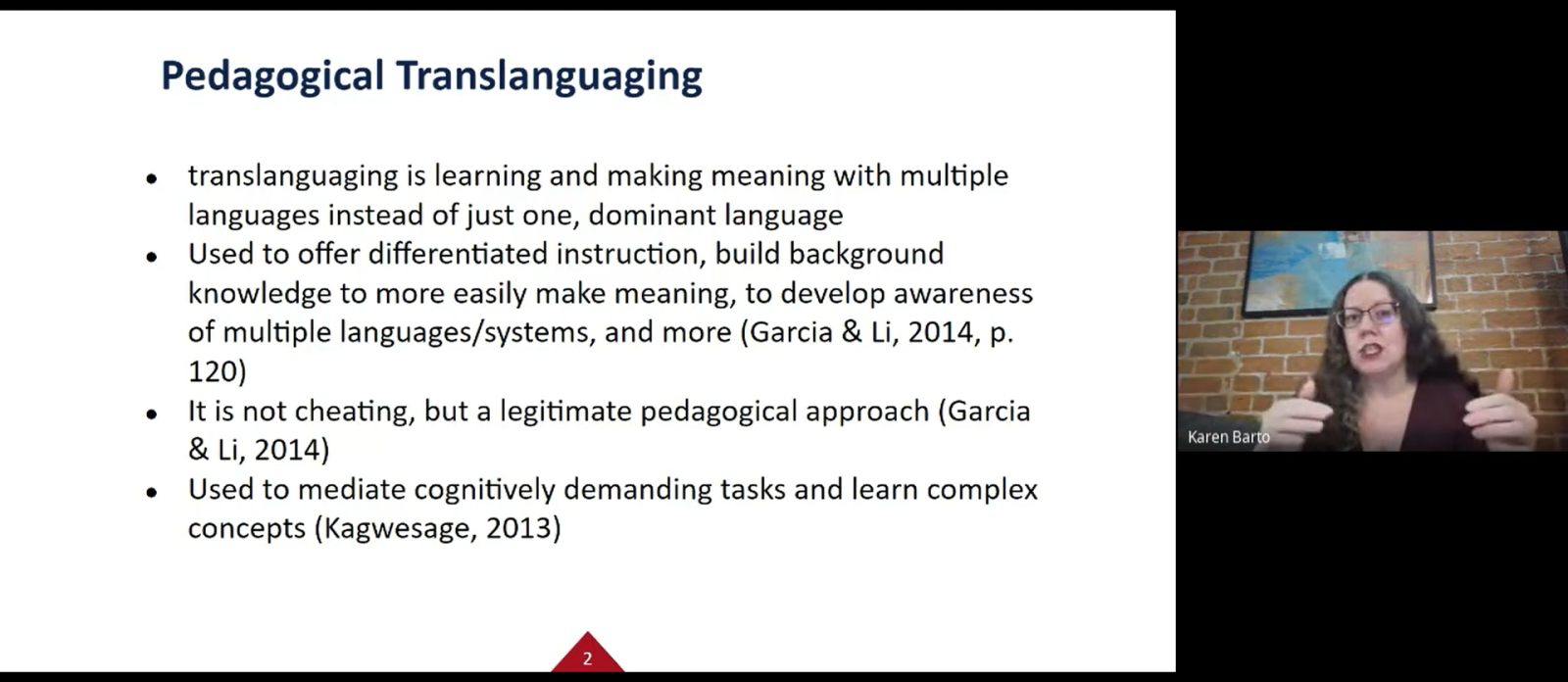
After the teamwork, Karen Barto recapitulated pedagogical translanguaging.
It is meant to learn and make meaning more easily by developing the awareness of multiple languages or systems as background knowledge,
and is “used to mediate cognitively demanding tasks and learn complex concepts.”
Karen Barto also shared three case studies of translanguaging used.
In general, translanguaging has its advantage for intercultural purposes by translating different languages back and forth.
The Vietnamese case showed that when translanguaging was not allowed, students’ performance of making presentations turned out quite bad,
while the Korean case of science class demonstrated that incorporation of translanguaging helped make students engaged and deepen their understanding of concepts.
5. Team teaching─The last approach Karen Barto recommended is that students can also serve as teachers to re-teach recent new concepts,
work in a group to prepare new content, and assist those falling behind with their learning.
Multiple instructors can also collaborate to focus on language and content aspects respectively.
#AIT #ELS #EMI