EMI Online Workshop: English Snacks: Bite-sized Tips to Improve English Skills and Confidence
【NSYSU X AIT】English Language Specialist Program
EMI Online Workshop Junior III: English Snacks: Bite-sized Tips to Improve English Skills and Confidence
•Date: 24, June 2022, Friday, 14:00-17:00
•Specialist: Dr. Karen Barto
For the third Junior level workshop “English Snacks: Bite-sized tips to improve English skills and confidence,”
Dr. Karen Barto focused on building non-native speaking teachers’ confidence in EMI context through recognizing strengths,
highlighted consideration for intercultural competence and communication norms, and shared and inspired tips for integrating English into everyday life.
Non-native English speaking teachers often worry their occasional linguistic mistakes and students’ perception of them.
As non-native speakers of English, however, teachers have the advantage of being able to empathize well with students’ struggles and difficulties in EMI context.
Modeling risk-taking and growth themselves, teachers will inspire students and bring them motivation.
Sustaining concern for open communication is also of immense importance.
When interacting, especially with international students, teachers will definitely encounter unexpected communication norms which lead to misunderstandings,
and open-mindedness and willingness to keep constant communication help effectively to avoid the problems to great extent.
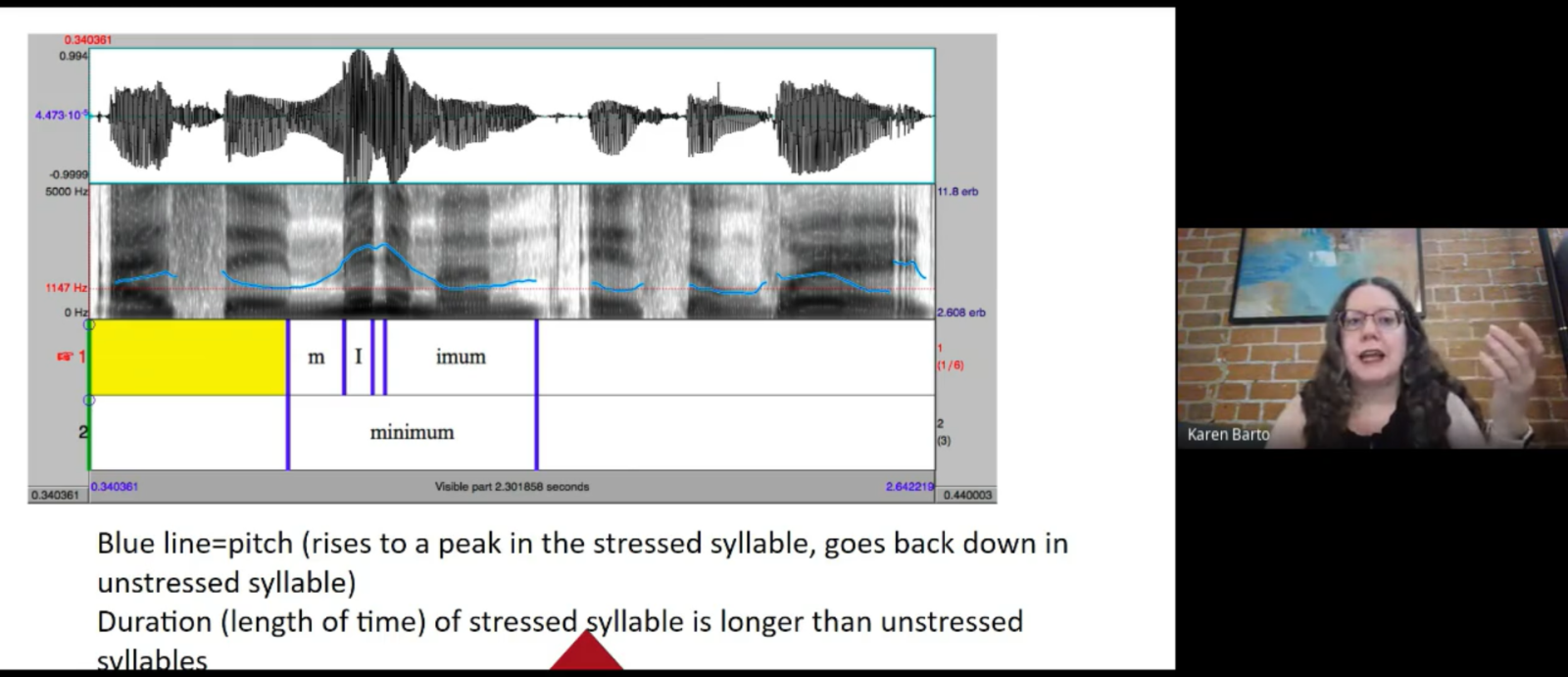
As a bonus tip, Karen Barto also emphasized the impact of word stress and pronunciation on intelligibility in English.
Word stress shows up on the stressed syllable with increased volume, longer duration, and wider pitch range/contour.
She recommended that participants make it a habit to practice pronunciation with online dictionaries to increase intelligibility, awareness of patterns, and serve as a model for students.
At last, she introduced other ways to have fun and build confidence in English at the same time,
such as incorporating English into daily communication, English journaling/free-writing, cooking new recipes, enjoying English-language entertainment, and so on.
※Strengths of Non-Native Speaking Teachers:
It might be quite intuitive to think that in terms of giving EMI instruction,
non-native speaking teachers are necessarily in a disadvantageous position compared to native speaking teachers.
Non-native speakers are more prone to worrying about making mistakes and their pronunciation, vocabulary, and grammar in front of students.
In a nutshell, it is common to feel uneasy speaking in a foreign language.
However, Karen Barto would like us to recognize the particular strengths non-native speaking EMI teachers have.
As a large-scale survey study in 2006 indicates, advantages of non-native speaking teachers include:
Students are much more inspired because they can see the teacher as a model for language learner.
Because of the shared language background, non-native speaking teachers are better able to anticipate and prevent language difficulties
since they are informed by experiences as learners of this language.
In general, the shared cultural background, regular habits, or perspectives often lead to better understanding of students’ needs.
With a shared first language, a beneficial multiple-language setting and translanguaging would be available.
※EMI Teaching Effectiveness, Language, and Training:
Researchers have studied the effectiveness of non-native speaking teachers’ EMI instruction.
A 2018 study in Finland shows that after EMI training was completed, instructors,
who were originally worried most about English pronunciation, accuracy, and fluency,
actually benefited most from reflecting on EMI and giving practice lessons that received individualized feedback and individualized language support;
Another study in 2001 indicates that pedagogical approach is more important than English proficiency for students to understand the lecture.
Bringing up these two cases, Karen Barto would like to encourage teachers to be more student-centered and confident.
English proficiency actually does not matter as much as we think it does, neither does confidence entail making no mistakes.
Quite the contrary, when sometimes teachers fail to articulate their ideas, carry out the lesson as planned, or feel awkward,
it also serves as a great chance for students to recognize that they themselves do not have to be perfect to talk and be confident.
On the other hand, application of strategies is also required to manage a lot of areas of difficulty.
After all, to excel solely the instructor’s English does not miraculously enhance students’ level of language.
※Intercultural Competence and Communication Norms:
Apart from the instructor’s proficiency and confidence, intercultural competence and communication skills are also crucial in EMI format.
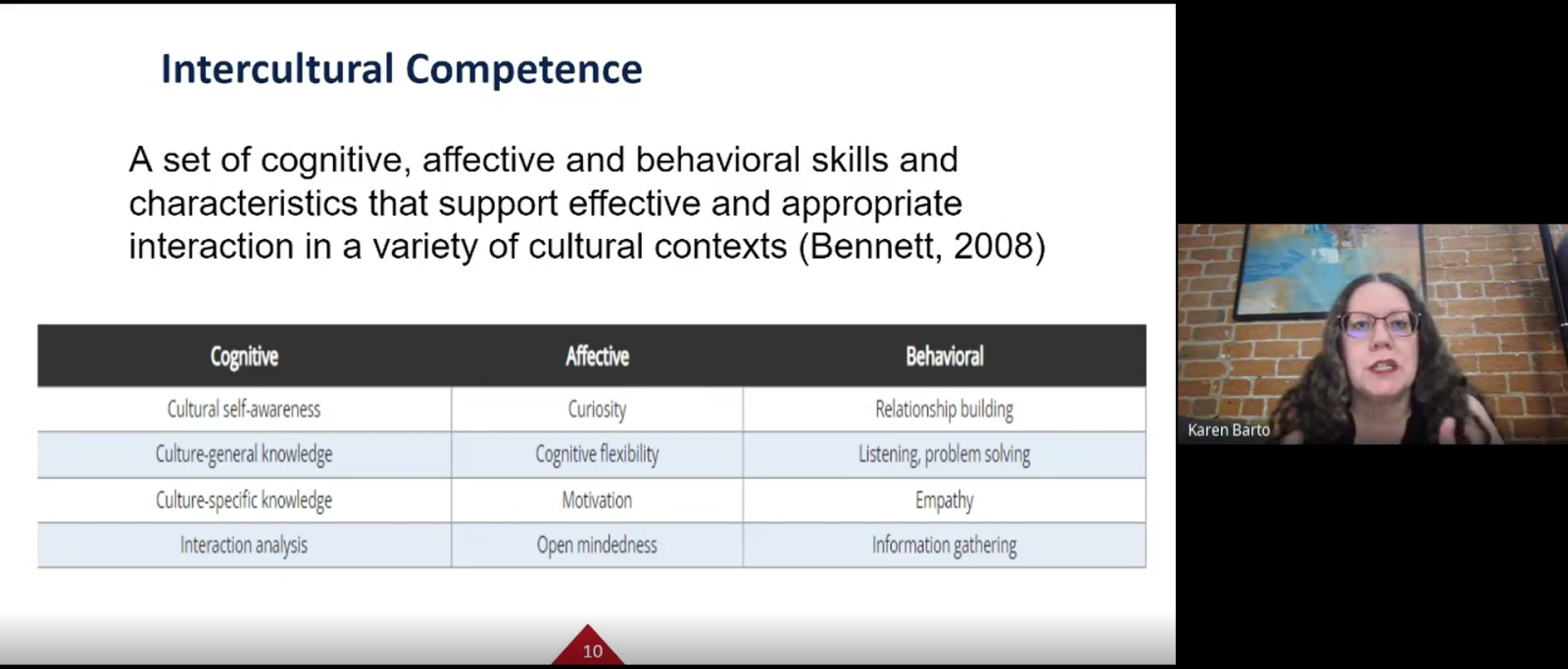
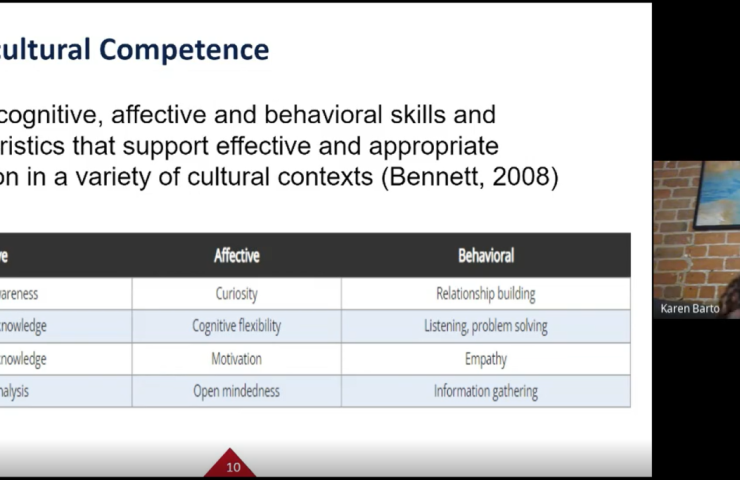
Intercultural competence encompasses “a set of cognitive, affective, and behavioral skills and characteristics that support effective and appropriate interaction in a variety of cultural contexts.” (Bennett, 2008)
Cognitively, being equipped with cultural self-awareness and cultural-general and –specific knowledge
will enable us to accommodate cultural differences and thereby defter at interaction strategies.
The affective dimension might be the most important:
sustaining curiosity toward the other and their differences, cognitive flexibility, motivation, and open-mindedness
are all the attributes most conducive to supporting intercultural relations.
These aspects will also be manifested in behavioral practices, which include relationship building, listening and problem-solving, empathy, and information gathering.
In a nutshell, to communicate more effectively, when the other’s norms are not what we expect or even offend us,
probably due to cultural differences or personal reasons,
we should all the more assume that there is a misunderstanding before assuming it is a bad intention.
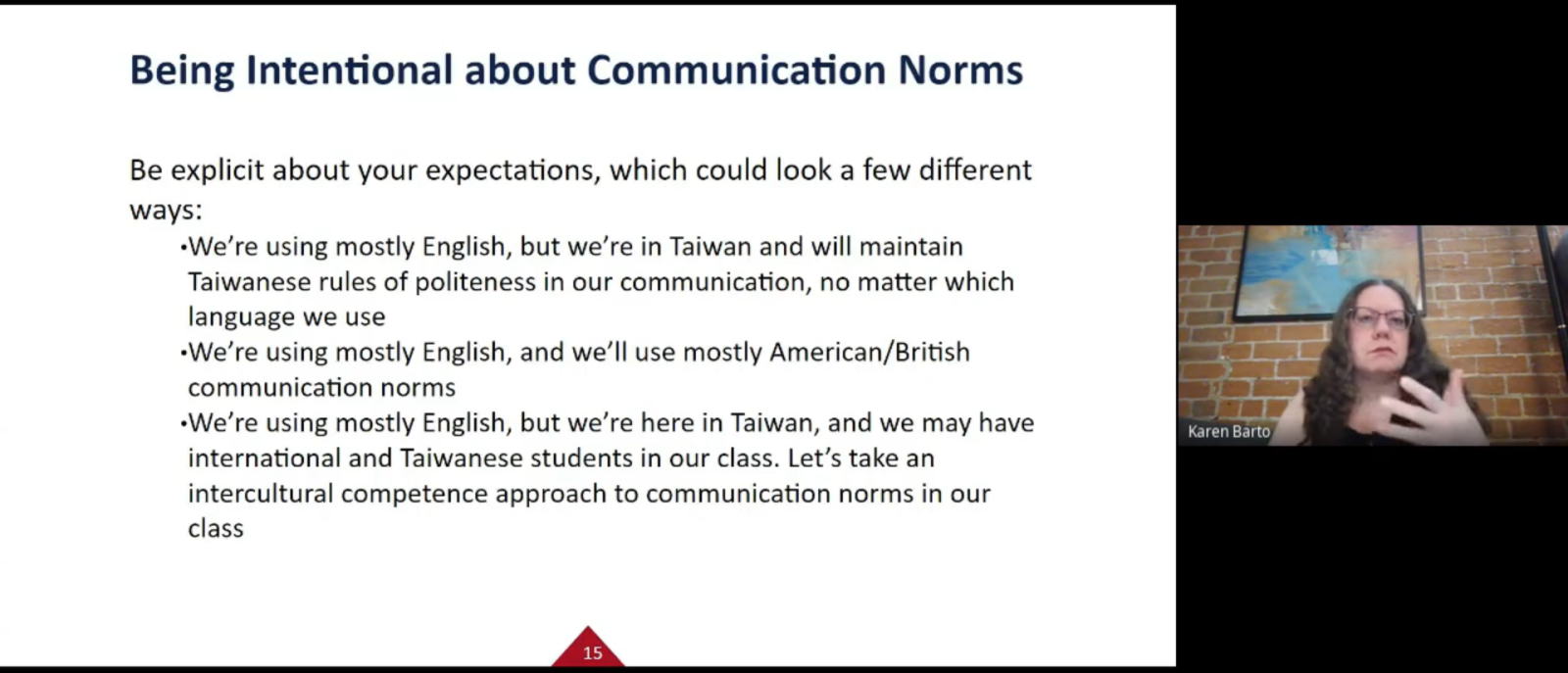
The difference between local and western/international patterns or norms of communication is also worth consideration,
which will be helpful for concerns in relevant educational situations inclusive of ways to address professors and classmates,
appropriate language in email and other contexts, appropriate topics for “small talks”, amount of personal detail given when excusing for an absence, etc..
To achieve good communication with students, the best approach may be being explicit about your expectations of norms of communication
according to the composition of students in the class and linguistic aspect of the context.