EMI Online Workshop: Strategies for EMI Peer Mentoring
【NSYSU X AIT】English Language Specialist Program
EMI Online Workshop Senior I: Strategies for EMI Peer Mentoring
•Date: 29, June 2022, Wednesday, 14:00-16:00
•Specialist: Dr. Karen Barto
The senior level of the workshop series is intended for training peer mentors capable of providing teaching consultation and advisory classroom observation service.
Dr. Karen Barto elucidated the details required to bear in mind to engage in peer mentoring relationship.
※ Types of Mentor Relationships:
To begin with, Dr. Karen Barto listed four common types of mentor relationship:
1) Official mentoring which is allowed or mandated within an institution or system and contains wide range of requirements, reporting, and expectations.
2) Unofficial mentoring which is often developed organically from connections made and can be more successful because they are built on shared interests and values.
3) Hierarchical mentoring in which a more experienced mentor answer questions and advises mentee on what and how to do.
4) Peer mentoring can be hierarchical or non-hierarchical. Collaborators can play roles of mentor and mentee at the same time.
※Effectiveness and Goal-setting in Mentoring Relationships:
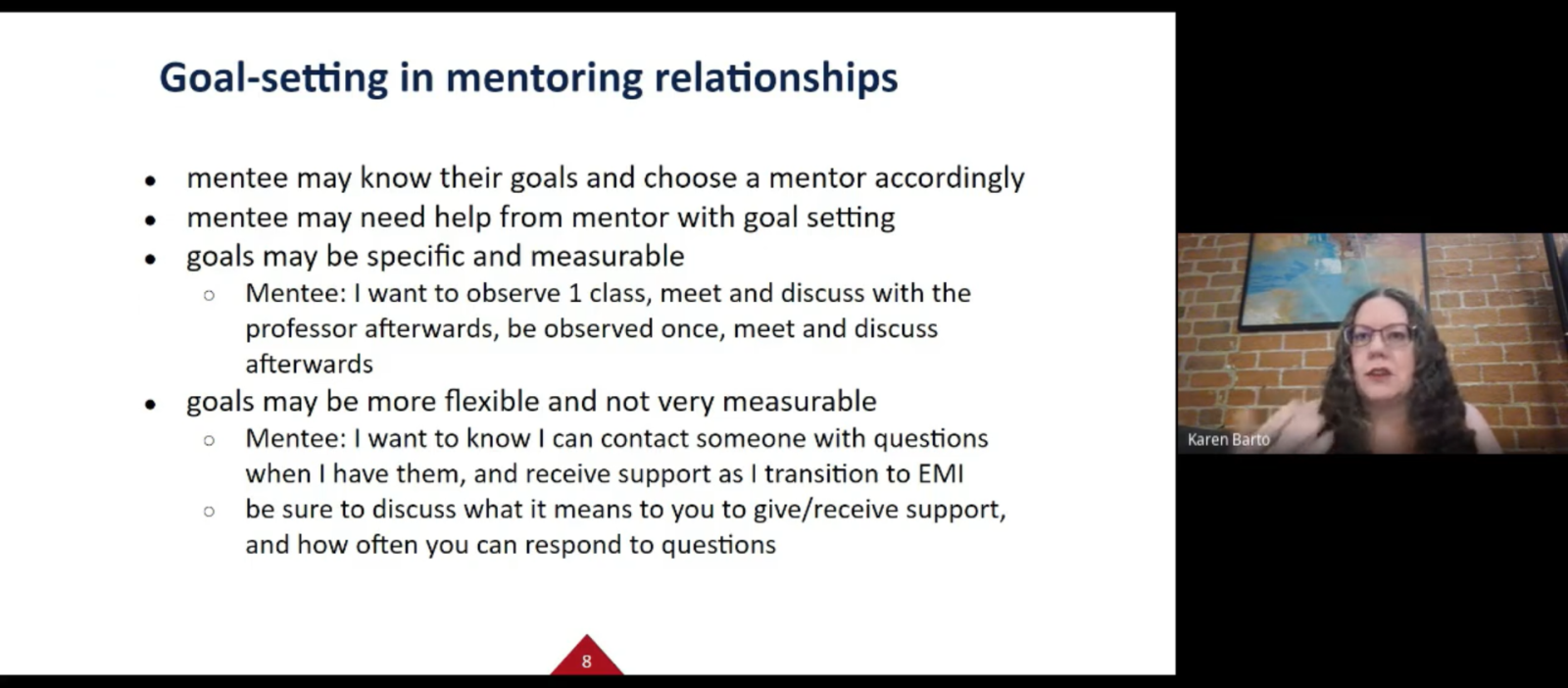
Whatever type of mentoring one is conducting, achieving effectiveness is the common goal.
When mentoring, an accountable attitude is often adopted, namely, the mentee is expected to meet certain criteria or expectations.
However, Dr. Barto suggested that a supportive attitude be adopted to offer practical support for the mentee to achieve the expected goals.
Both the mentor and mentee should understand clearly what is expected of them respectively.
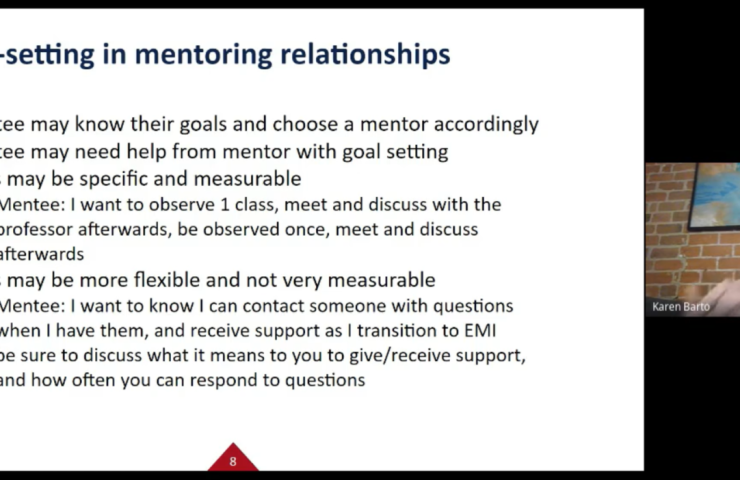
When setting goals, they are usually specific and measurable,
but can also sometimes be flexible for the mentee to discuss the specific support in need and the expected mode of communication with the mentor.
※Group Discussion: Past Experiences as a Mentor and Mentee:
In the first round of group discussion, professors shared their past experiences as mentors and mentees.
Expectedly, their experiences are limited to official ones such as the mandates in the university,
and the form they are most familiar with is that of teacher-student relationship.
Probably the most fundamental mentor relationship one experiences is that under instruction to complete a thesis or dissertation.
Most participants expressed that it was really helpful and reassuring when their thesis advisors were supportive and encouraging, and that is what they would like to copy as a mentor.
However, when it comes to teachers’ peer mentoring, such a parental mode can be condescending or too hierarchical.
Gender dynamics can be another issue if one lacks the experience of mentoring a peer of different genders.
In general, to listen as fully as possible to whoever one is working with, the differences of genders, ages, ethnicities, and other identities,
should be taken into consideration so that the mentee will feel more empathy from the mentor and the mentoring will be more successful.
※Steps in the Mentoring Process:
As we tend to become a mentor the way we were mentored,
examining past experiences is the key to rethinking and determining how we would like the mentor-mentee relationship to be.
Bearing in mind the mentoring procedure will be of great help to engage in a mentorship.
Once the mentor and mentee are matched, it is important to confirm both sides’ expectations and goals and the length of mentorship through clear and open conversation.
Finding the reasons and significance of why one is in a mentorship will be helpful to clarify what is expected.
After the mentorship is carried out as discussed, it can be decided whether to end it or re-establish another.
※The Role as a Mentor:
Ideally, the mentor should be able to guide and facilitate, and listen fully and actively to the mentee.
In general, it would be better to resist sharing opinions until the mentee expresses the full set of ideas,
and meanwhile, the mentor should try to display attentiveness and be present with gestures, facial expressions, and so on.
When giving suggestions, instead of providing exact directions,
it would be more valuable to support the mentee in the problem-solving processes such as connecting them with resources (other people, information, materials, etc.).
There might be occasions where a piece of direct advice can fix the problem easily.
However, the general principle is to keep the conservation open and be critical and analytical about the given situation without being evaluative.
Most importantly, encourage the mentee as much as possible supportively and respectfully.
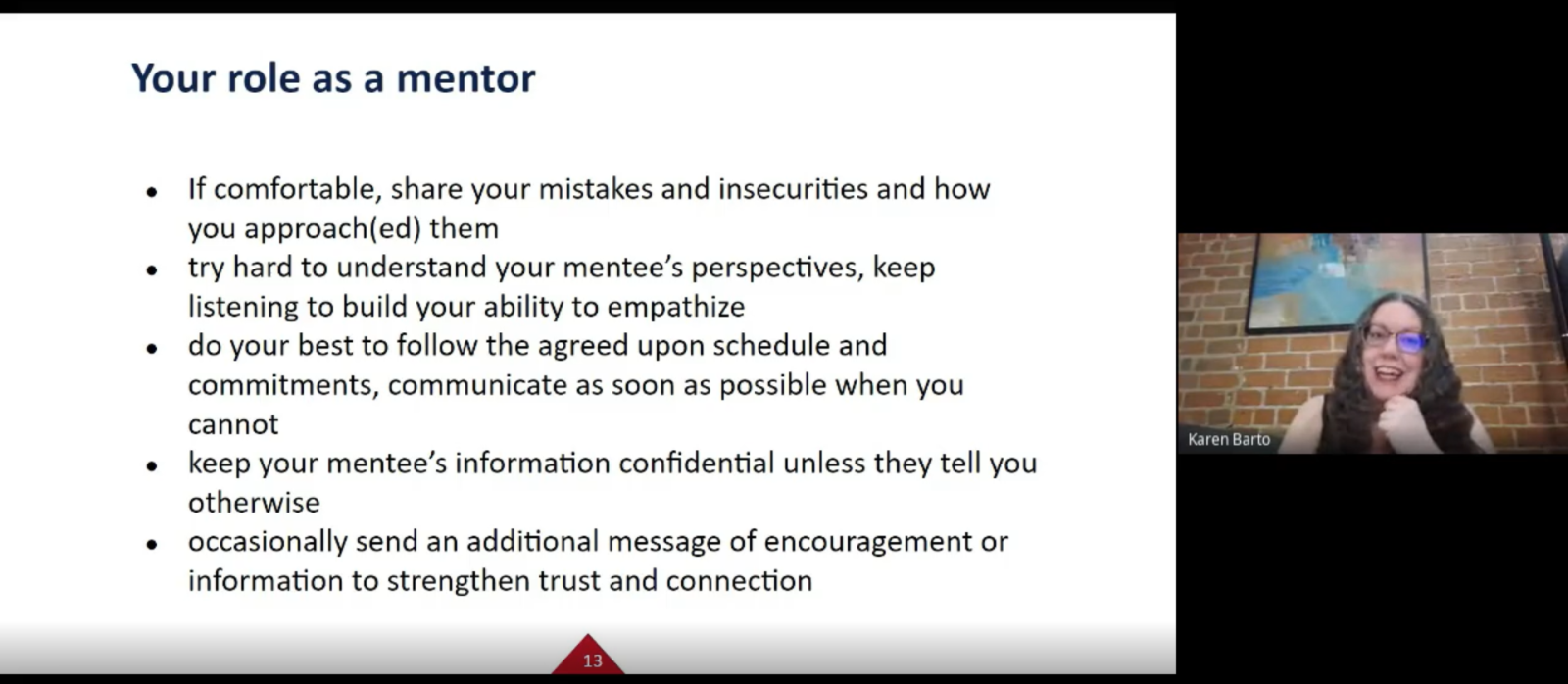
If comfortable, despite being a mentor, do share your mistakes and insecurities and how you approached them.
To build trust between each other, also try to understand the mentee’s perspectives and develop the ability to empathize;
on the other hand, keep the mentee’s information and concerns confidential.
The last technique is to occasionally send a message of encouragement or information to strengthen trust and connection.
※ Be a Mentor and Mentee:
In real condition, one is usually a mentor and mentee at the same time.
When we are in a partnership to support each other as co-mentors,
we can learn more in our EMI practice than working individually, since our different strengths will allow us to support each other in different areas.
※ Peer Mentor Planning Guide:
In the second round of group discussion, Karen Barto asked participants to share thoughts on establishing their own mentoring relationship through the planning guide she designed.
Questions worthy of consideration include: what are the pros and cons of choosing a partner at one’s own or other institution, and in one’s own, adjacent, or even unrelated field?
What are my expectations for myself as a mentor and mentee in terms of attitude and availability
(including concerns of formality, privacy, respect, hierarchy, mode or site of communication, frequency)?
※ Communities of Practice:
Finally, Karen Barto explicated the advantage to form communities of practice in which people with shared interests or goals can collaborate to learn from each other.
Working as peer mentors, putting EMI knowledge into practice by responding questions, staying in touch with workshop mates,
supporting each other in being effective mentors by sharing experiences, problems, victories.
All in all, do not think you have to do it alone!