EMI Online Workshop: Professional Class Observation Skills
【NSYSU X AIT】English Language Specialist Program
EMI Online Workshop Senior II: Professional Class Observation Skills
•Date: 6, July 2022, Wednesday, 14:00-16:00
•Specialist: Dr. Karen Barto
The senior level of the workshop series is intended for training peer mentors capable of providing teaching consultation and advisory classroom observation service.
Perhaps the most effective and practical approach to improving one’s teaching quality,
practicing class observation deserve considerable encouragement with regard to cultivating EMI proficiency.
Focusing on class observation skills in this session, Dr. Karen Barto began by explaining the purposes of class observations and the affect it may induce.
While teachers can benefit either from observing a class or from receiving feedback from observers,
the affect may remain a problem to be overcome, namely the uncomfortableness and cultural inappropriateness in such a context.
Both the instructor and students can feel nervous being judged and evaluated by an “outsider.”
However, participant observers may also be helpful by serving as collaborating teachers.
Before doing observation, there are several aspects, expectations, and information supposed to be made clear to smooth the observation process.
Pre-observation procedures, inclusive of certifying observation modality, developing observation protocol, establishing guidelines,
having schedule arranged, and getting contextual information notified, are crucial for effective and efficient class observation.
The more clear the observed teacher know about the observation process means less anxiety and more authentic teaching.
When observing, remember to follow these established guidelines.
After observation, the observer is supposed to give timely feedback.
To become a professional peer mentor, the capacity to formulate and give non-evaluative feedback is vital to acquire.
On most occasions, non-evaluative description is a lot more effective in showing the observer’s insight and reflecting on the observed lesson than purely judgmental and evaluative comment.
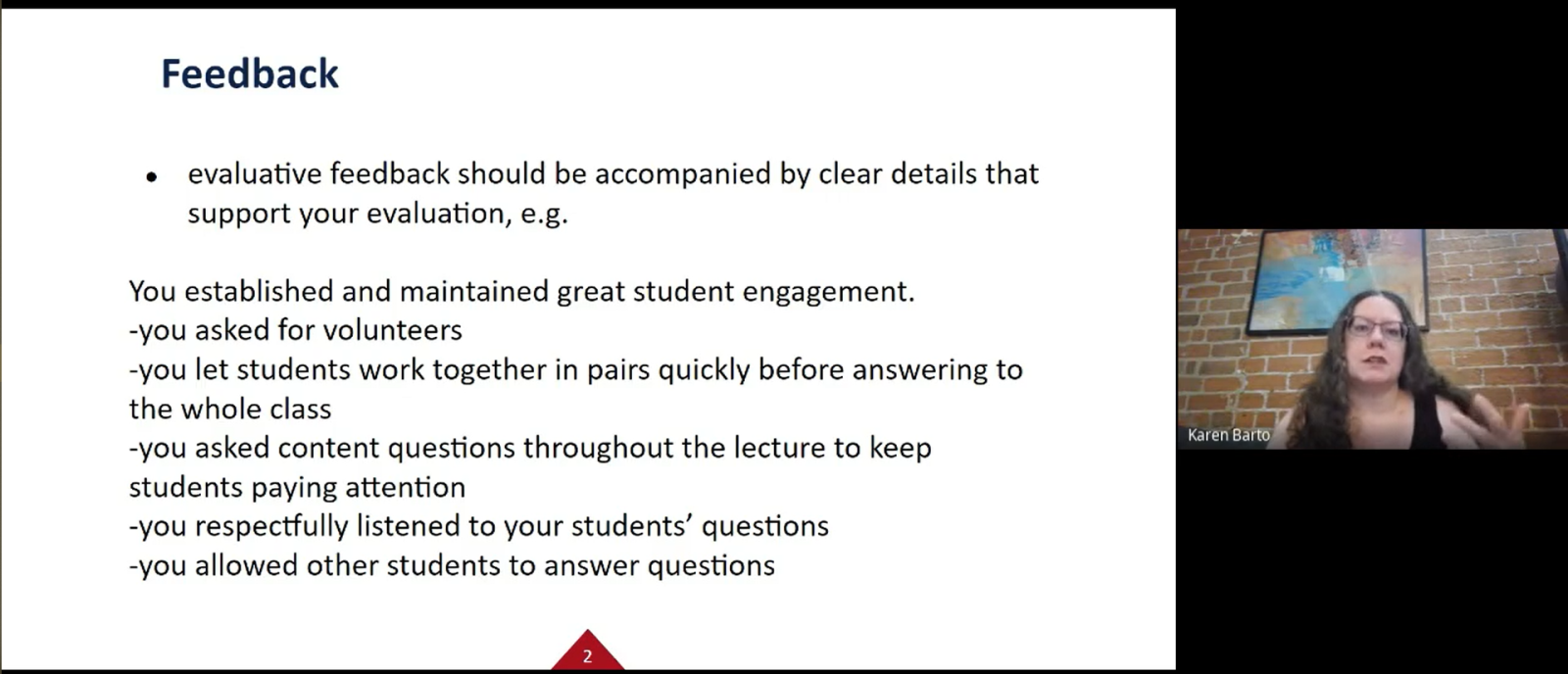
When evaluative feedback is necessary, details should be provided to support the evaluation.
As for the instruments for observation, the observed teacher should be allowed decision on categories that should be included and prioritized, and opportunity to give feedback on changes needed in observation form.
The purpose of class observation is, after all, supposed to support teachers with their professional growth.
In conclusion, when playing the role as observer, be clear about the goals,
communicate clearly and respectfully with the teacher observed, and establish a protocol and follow it.
※Purposes of Class Observations:
- To gain ideas for teaching practice: observe a specific skill or topic being taught, pay attention to patterns in classroom interaction and use of technology, English scaffolding, content scaffolding, etc..
- To offer feedback and encouragement: general suggestions or focused on specific patterns or aspects, i.e., encouraging student participation, time management.
- To evaluate: Evaluation may be general or focus on a specific pattern.
※Affect and Class Observations:
Concerns:
- Both students and teacher may feel uncomfortable since observers may be regarded as intruders in class.
- Observed instructors may feel undermined in their authority as professors.
- Teachers may feel nervous about judgment and worry about teaching performance; students may be nervous about being evaluated by an “outsider.”
Benefits:
- Observers may be “extra hands on deck,” adding novelty and alternative explanations, “team-teaching” to foster discussion and provide feedback,
answering questions when no students do, or assuming the role of a student and asking questions. - Teachers being observed get counselors to ask questions, plan lessons together, or receive advice after observation.
Simply the awareness of going to be observed makes one reflection on what is unthought-of before, and new teaching ideas may spark during the process.
※Before and in Observation:
- Observation Modality: Consider the format to be online or face-to-face, and synchronous or asynchronous if online, and their respective advantages and disadvantages.
- Establish Guidelines: 1. Make your expectations explicit and listen to the observed teacher’s desired goals.
2. Using a chosen observation form with consideration of the context and goals of the observed class.
3. Discuss how feedback will be given and received. - Schedule Observation: The day/time when the observation will occur should be established and treated with respect.
- Get Contextual Information: Before observation, observers should be informed of the contextual information of the observed class through pre-observation meeting or feedback form:
1. The status of the to-be-observed class in the entire course and program
2. student population and demographic
3. Difficulties the instructor had experienced with this group/class.
4. Consider and communicate about both sides’ goals in observation.
5. Review the chosen observation form thoroughly. - When Observing: 1. Arrive on time and avoid being “invasive” in class.
2. Use the observation form to structure note-taking during the process.
3. Follow previously established guidelines about your role as observer.
4. Share the purpose of observation with students.
※Giving Feedback:
Give Timely Feedback: Review the notes and prepare your comments or evaluation with the observation form.
Share written feedback for review and reflection and consider a face-to-face meeting for rapport building and discussing written feedback.
※Non-evaluative Feedback:
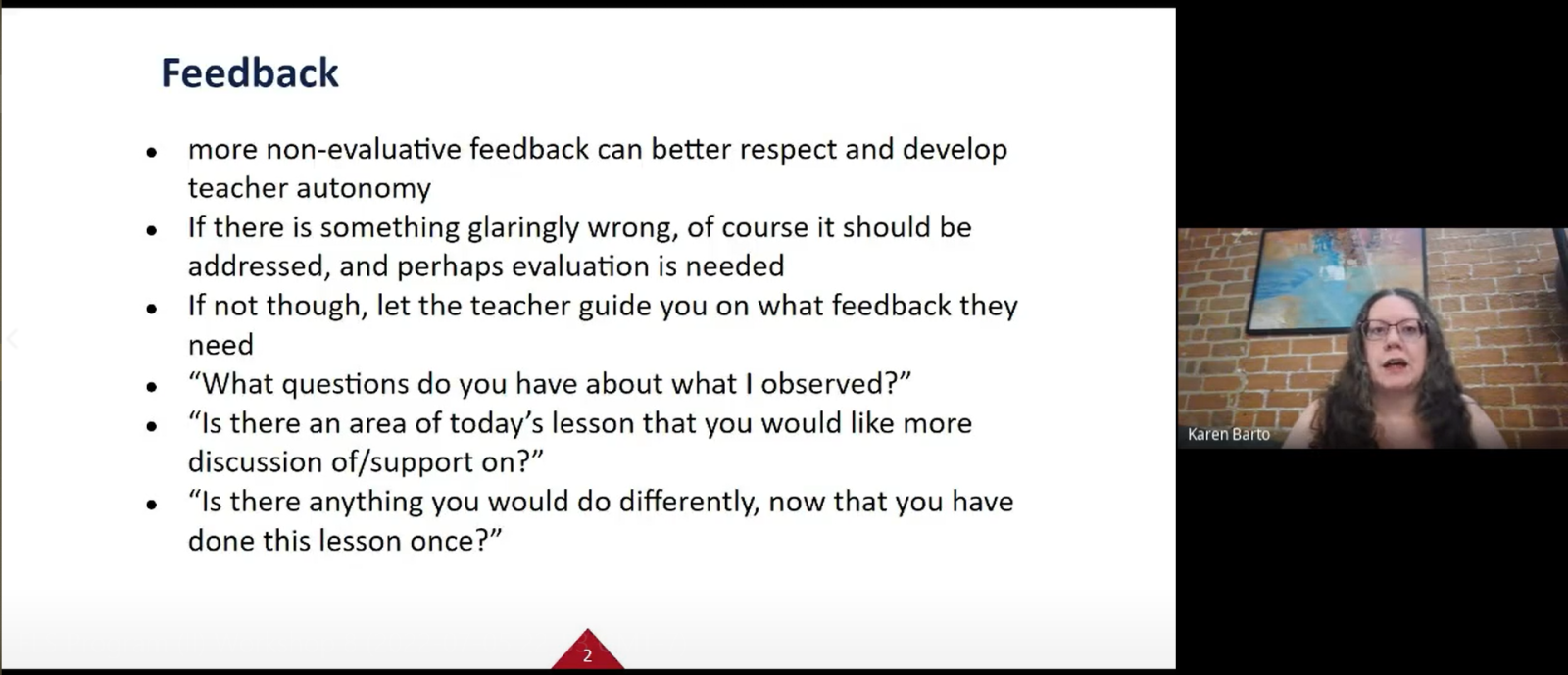
When it comes to giving feedback, either praising or pointing out a defect of certain aspects of an observed lesson,
non-evaluative feedback is usually preferable to judgment or evaluation. Instead of giving expressions like “It was great that…” or “It’s a pity…,”
describe what you observe (with goals considered), since your description can serve as a springboard for their reflection, asking questions, discussing goals, practices, ect..
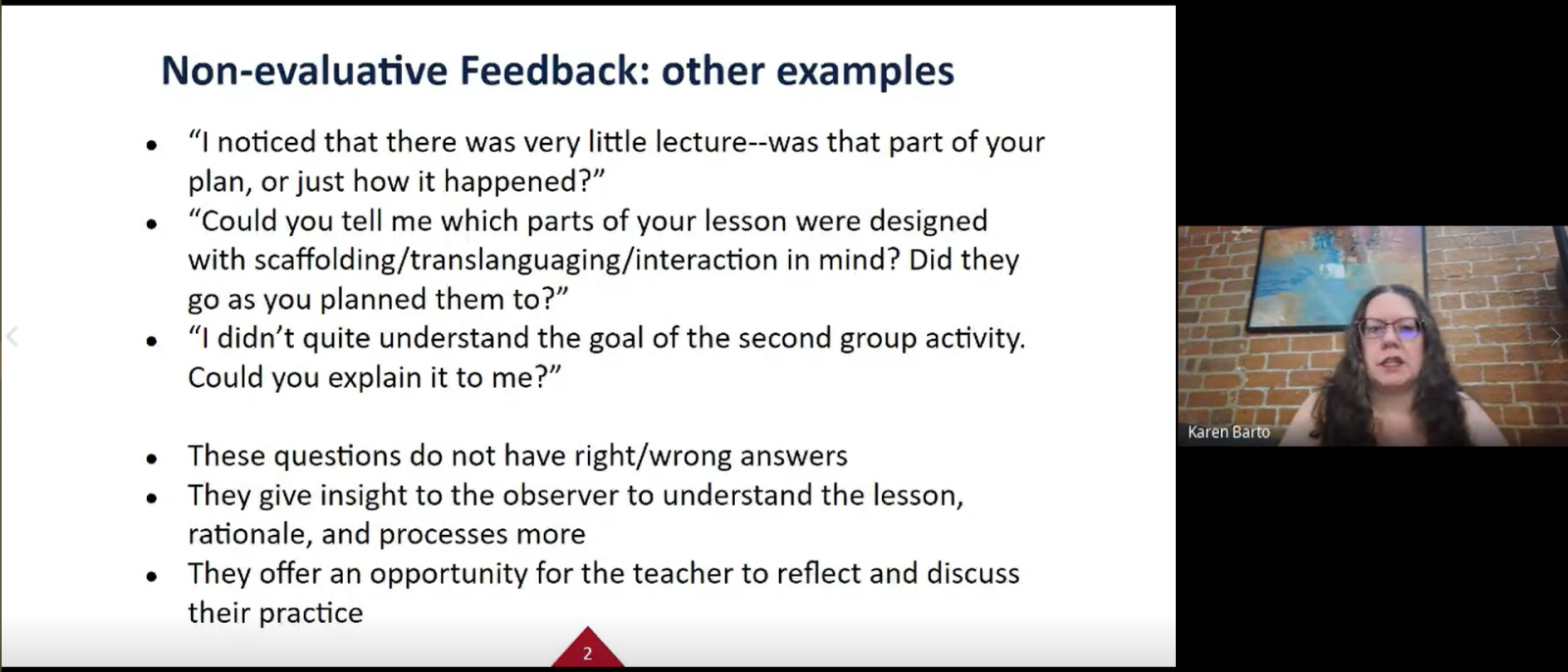
When it is required to ask questions for further clarification of the lesson plan or what has gone on, being non-evaluative also avails.
Demanding no right or wrong answers, non-evaluative questions show the observer’s insight into the lesson, rationale, and processes more, and offer an opportunity to reflect and discuss teachers’ practice.
In general, more non-evaluative feedback better respect and develop teacher autonomy.
When the teacher’s performance deserves praising and evaluative feedback should be given, remember to provide clear details to support your evaluation.