EMI Online Workshop: EMI Strategies and Language Use
【NSYSU X AIT】English Language Specialist Program
EMI Online Workshop Entry II: EMI Strategies and Language Use
•Date: 21, May 2022, Saturday, 09:00-12:00
•Specialist: Dr. Karen Barto
Focusing on the issues of language use, in this online workshop session,
English language specialist Dr. Karen Barto pointed out the common challenges teachers often come across when teaching in EMI format,
enumerated concerns that should be borne in mind, and proposed approaches to confronting them. In this session, Dr. Barto also launched three times of group discussions.
Teachers shared EMI experiences from different disciplines, thoughts on integrating English into the course, and EMI strategies they once used or considered applying.
Since building teacher-student connection is also important in EMI, Dr. Barto asked teachers to share their favorite tourism spot.
The purpose was to prompt teachers to think about the reverberation of asking such a private question for fun in class, if it precipitated the discussion of other questions, and if it helped to make the atmosphere relaxing.
※ EMI Challenges and Concerns:
Common problems when conducting EMI classes include difficulties in integrating EMI into content knowledge,
abrupt transition to EMI that neglects students’ understanding, lack of confidence in using English (in this case of both teachers and students),
learners’ inadequacy to deal with EMI courses, which leads to withdrawal, discrepancy of student linguistic competency in class, etc.
In general, there are always more difficulties in learning new knowledge through a foreign language, since thought needs to go through additional processing of language.
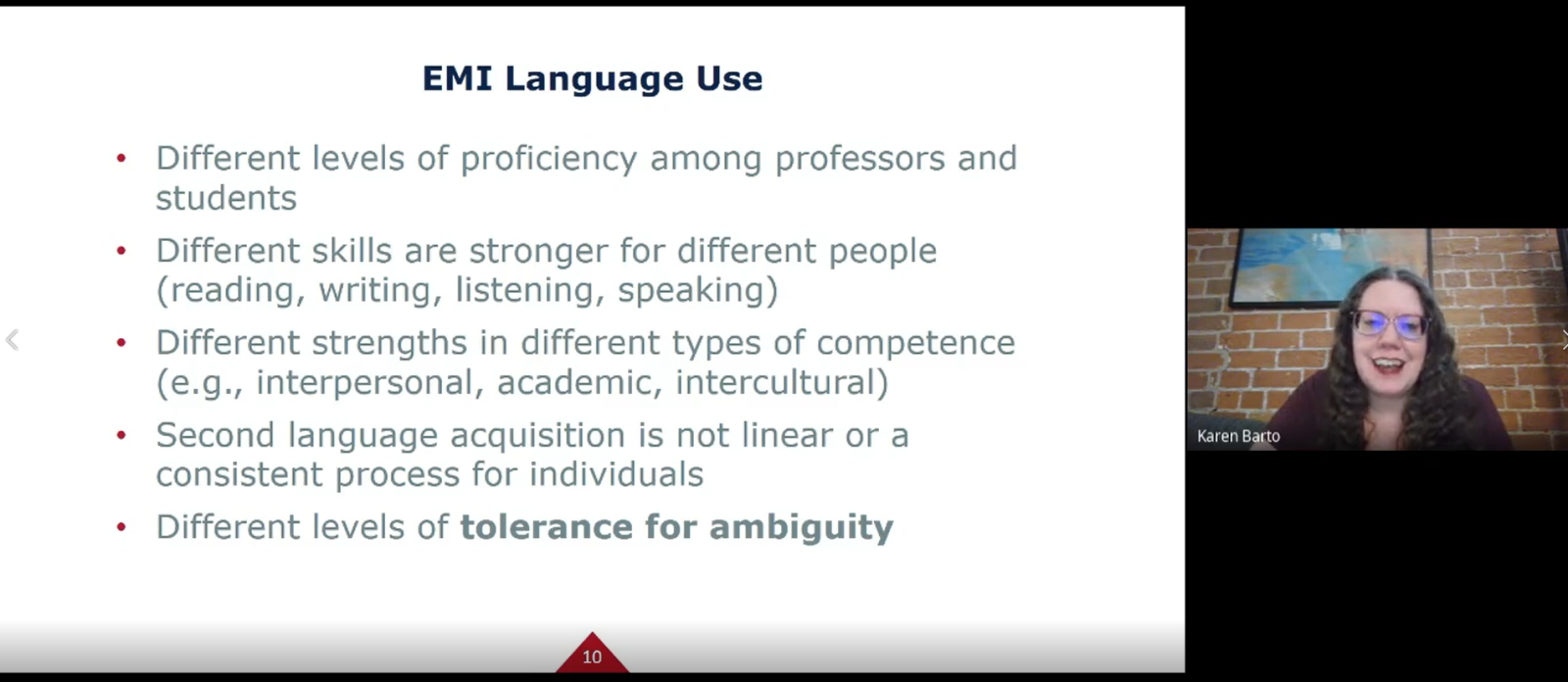
※ EMI Language Use:
Second language acquisition is neither a linear nor a consistent process.
Students in a classroom may be in different levels of English proficiency,
possess different language skills in certain aspects (reading, writing. listening, or speaking), and have strengths of different types or fields.
We cannot expect that till the end of the semester, students’ deficient aspects can have salient improvement.
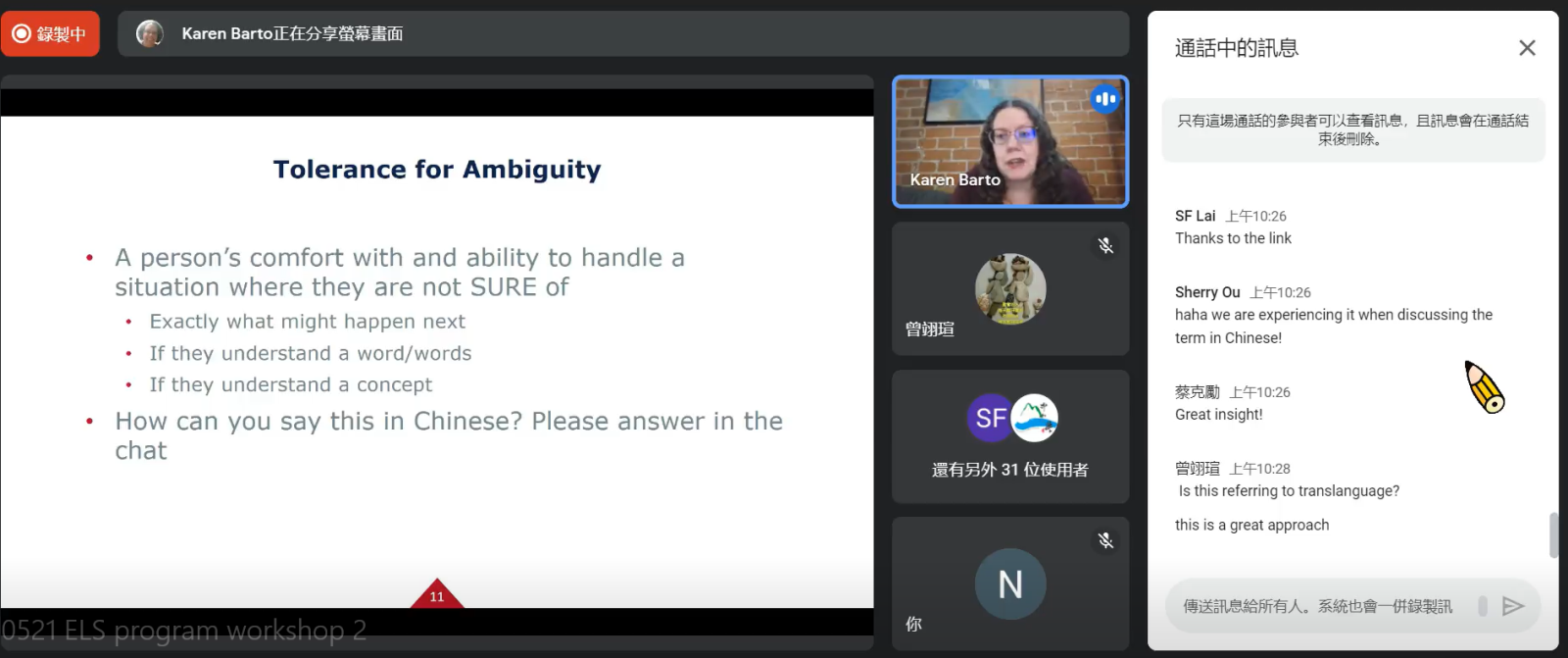
Everyone in the class, after all, has different tolerance for ambiguity.
Therefore, the teacher must have more patience and care to deal with every student’s learning.
※ EMI Strategies:
1. Honesty and Empathy─When the course cannot be implemented as planned due to time limitation or other unexpected situations,
be candid and discuss curricular changes with colleagues and also students;
there are definitely many struggles in performing EMI, so to get students on board, be patient with them and yourself.
2. Gradual Transition─Take content, timeline, and student capacity into consideration. Build confidence progressively.
You can start by adding vocabulary and playing English videos with subtitles, and then work towards subtracting most of the Chinese.
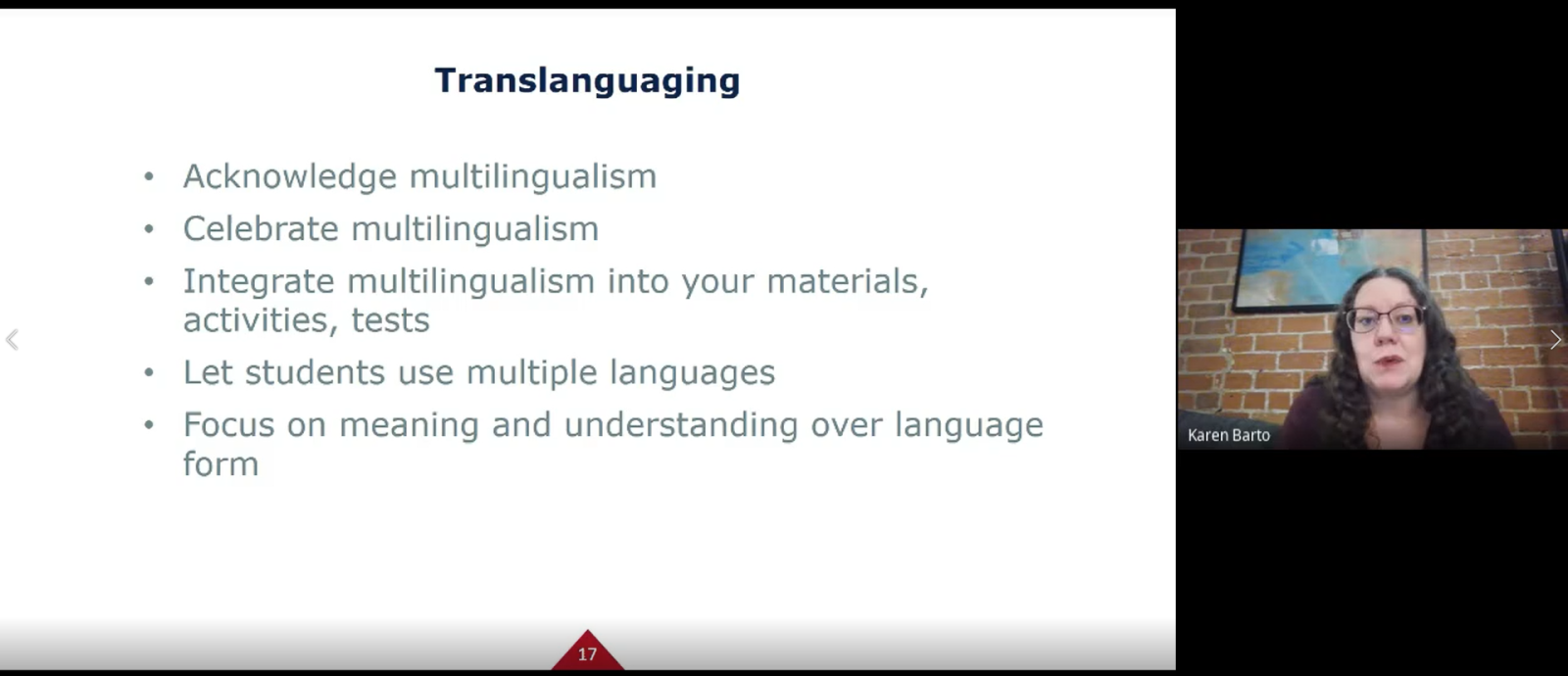
3. Translanguaging─Acknowledge multilingualism by integrating it into course materials and activities, |
allow usage of multiple languages, and focus on meaning and understanding over language form.
4. Scaffolding─Explain to students the arrangements of the course to build their awareness as learners, and break the lesson or content into small parts to guide their learning,
e.g., providing a glossary, highlighting important concepts and offering summaries, and carrying out activities to support their learning.
5. Learner Engagement─Keep learners active with discussions, templates to fill in, questions to answer, and toss some random fun to help build teacher-student connection.
#AIT #ELS #EMI