EMI Online Workshop: Discussion and Scaffolding Strategies
【NSYSU X AIT】English Language Specialist Program
EMI Online Workshop Junior II: Discussion and Scaffolding Strategies
•Date: 17, June 2022, Friday, 14:00-17:00
•Specialist: Dr. Karen Barto
Guiding students to understand the concepts step by step is fundamental to giving instruction, and the term designating this pedagogical strategy is “scaffolding.”
On the other hand, the skills that help organize and lead discussion is also indispensable for successful scaffolding.
After commencing this session with warm-up meta-discussion for teachers to share what they were concerned and excited about leading discussion in class,
Dr. Karen Barto began the lecture by introducing the Theory of Comprehensible Input,
the main idea being that to sustain comprehensibility of the lesson content, incorporating learning and scaffolding strategies is requisite.
To attain comprehensibility as fully as possible, the teacher may apply strategies to make both the speech and materials explicit and encourage cooperation between students.
When giving instruction with scaffolding or learning strategies, the strategies themselves must be taught to help students develop self-regulated and independent learning.
Dr. Barto expounded on scaffolding by discussing it from several perspectives.
In terms of teaching and learning materials, teachers can either modify or design new materials to scaffold;
in the aspect of instruction, teachers can take advantage of graphic organizers or templates to guide and inspire students,
and design small quizzes such as that of multiple choice, cloze, matching, short answer to check student understanding.
Model assignments and rubrics are also great scaffolds that help students understand what is expected of them.
As discussion is a crucial part of a class, there are several aspects that deserve attention and strategies worth considering.
Surely there are challenges both professors and students would confront in discussions.
To engage students in discussion and reduce their anxiety,
Dr. Barto focused on how to create a relaxed community environment and formulate strong and clear discussion questions.
On the other hand, language use is also a major concern in EMI classes.
Dr. Barto proposed establishing language guidelines for students and tips for teachers to lead discussion and give feedback.
Last but not least, discussions should also be scaffolded to facilitate students’ output.
※Ways to Produce Comprehensible Input:
- Make speech comprehensible to our students: We may slow down our pace when speaking, put emphasis on key words or points, paraphrase frequently, or use visuals.
- Make texts comprehensible to students: If the content in textbook is too cluttered, we may focus on one section at a time;
annotations, study guides, and graphic organizers are also helpful when visual and organizational support are not available. - Encourage students to work together: Group work with clear work division (e.g., one read, the other paraphrases, draws and explains) guarantees low-stakes language practice with a content focus.
※Learning strategies:
- Cognitive: organize information
Cognitive strategies such as taking notes, annotating, previewing, using graphic organizers, and highlighting key vocabulary
can help organize information in a more concise and clear way, thereby making it easier to be evoked from long-term memory. - Metacognitive: purposeful self-mentoring
Metacognitive strategies, asking students to predict, infer, raise questions, or summarize course content
can help them understand how they learn spurring them to think about their thinking. - Language Learning: conscious use
To bring students’ language use to conscious level, we can help them with identifying word patterns,
grouping and labeling concepts and ideas, stirring logical guesses based on what they know about the language, and paraphrasing.
It is worth mentioning that when it comes to learning strategies, redundancy is good, especially across stages of the lesson.
By introducing and reviewing ideas in different media (readings, videos, lectures, ect.) or having students work with ideas both receptively and productively,
overlapping ideas will enrich the language and content input and reinforce comprehension.
※Scaffolding:
◎Types of Scaffolding
- Verbal:
- Restating students’ responses so that the language input can be diversified.
- Model how you work through an unknown.
- Correcting pronunciation, but only when the meaning is obscured.
- Procedural:
- Procedurally, teachers can shift from teaching to giving models (of completed assignments that meet stated requirements),
guided practice, independent practice with peers, and independent use of knowledge to gradually release responsibility to students.
- Instructional:
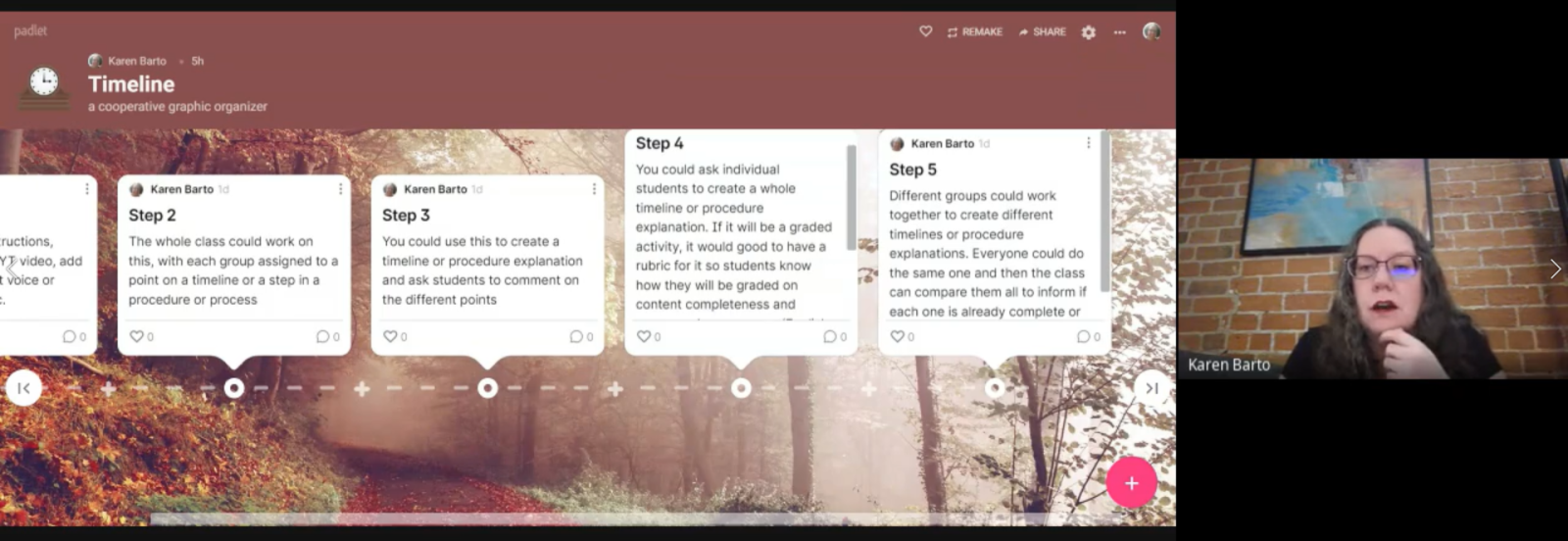
- Apart from the instructional strategies already mentioned, teachers can also use IRAts to reassure student readiness or timeline graphic organizer to scaffold.
◎Scaffolding Materials:
To help your student, you can either modify materials to scaffold or design new materials as scaffolds.
- To Modify English Matetials: Help your students approach new and difficult texts with development of schemata,
notice of important vocabulary or usage and of rhetorical structure of the used materials, and pinpointing what is essential in the materials. - To develop English Materials: You can create summaries of previous lessons, materials, and important concepts,
give synthesis of different introduced theories or approaches, offer outline or reverse outline, apply graphic organizers, and provide glossaries.
After you have instructed and modeled, students can learn to prepare summaries, syntheses, and graphic organizers, craft discussion questions and questions for tests, and contribute to co-constructed glossaries or vocabulary charts.
※Organizing and Leading Discussions:
◎To create a relaxed community environment,
- Encourage students to know each other, work together, and support each other.
- Show them it’s good to be wrong─if you’re never wrong in class, you’re not taking any risks.
- Allow noise and a little chaos─you are still a good professor even if the class doesn’t “look organized.”
- Reassure the students (and yourself) that you will all get more comfortable over time with practice in discussing in English.
- Consider holding some discussions online to allow quieter students a chance to shine, even if your class meets face-to-face.
◎To create strong and clear discussion questions,
- Make sure your question is open-ended and requires a unique response.
- Create materials that support the discussion─guides, forms to fill out, questions to answer, procedures to undertake.
- Have a system where every group records and reports at least some key points.
- Require at least some of the reporting be done in English.
- Consider “roles” for each student: note-taker, monitor (make sure everyone gets to contribute), resource manager, reporter.
- Consider translanguaging opportunities as discussion prompts
─students can be allowed to seek L1 materials and give a short review in English or seek L2 materials but be allowed to talk about it in both languages. - Incorporate task-based group work as a part of discussions
─focusing on a task can reduce students’ anxiety and the pressure to “say something smart” or “give the right answer.”
※Language Use in Discussions:
◎To guide discussion in an EMI class,
- You can involve students online or in-person group voice discussion, chat discussion online, or survey via google forms.
- Set the rule of percentage of English supposed to be used.
- Let students move from saying only key terms in English and to more English expression, little by little.
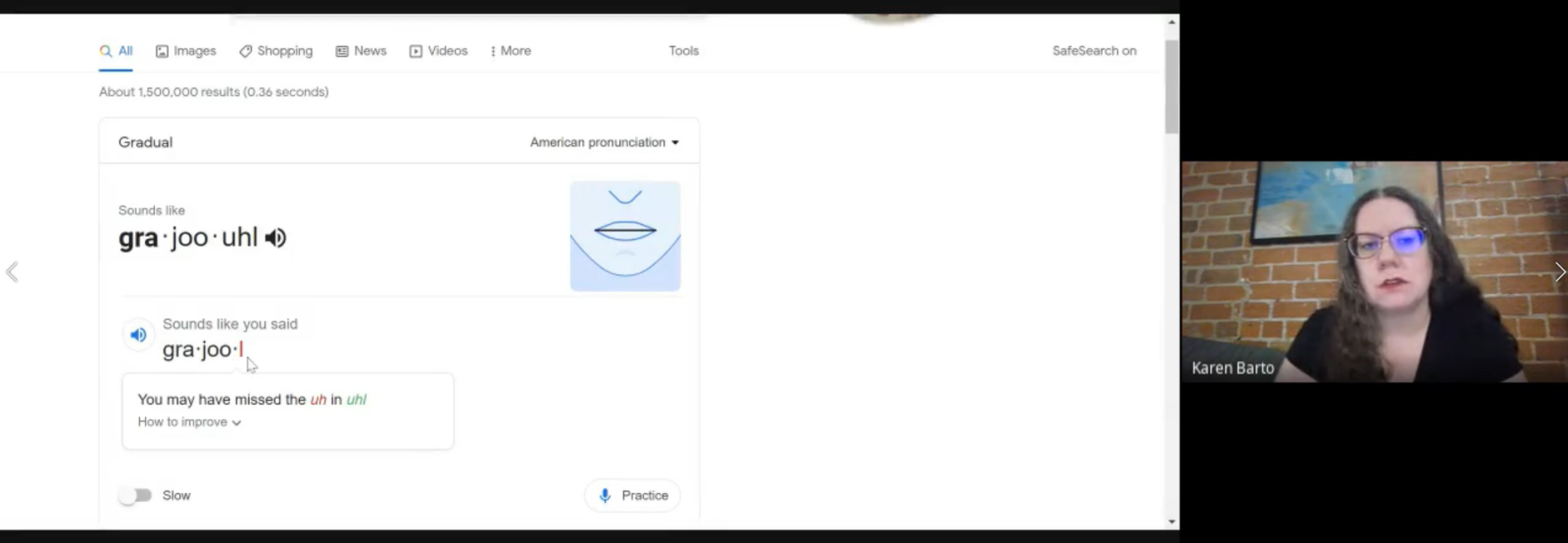
- Scaffold pronunciation of terms with Google dictionary and Pronunciation (google “how to pronounce ‘the target word’” and you can practice) or pronunciation sites.
- Keep “reading the room” to check if they are capable but still scared; push them a little to ease the anxiety of “showing off” in front of peers.
- Stay focused on the English they use, and praise and reward it.
◎To scaffold Discussions,
- Make instructions and expectations clear, consider instructing in both Mandarin and English to start.
- Give both verbal explanation for discussion guidelines and written instructions so that students can refer back to.
- Scaffold reporting ideas in English (giving a sentence with the expected keyword absent, for instance) to facilitate students’ output.
- Set the Tone for Discussion Boards.
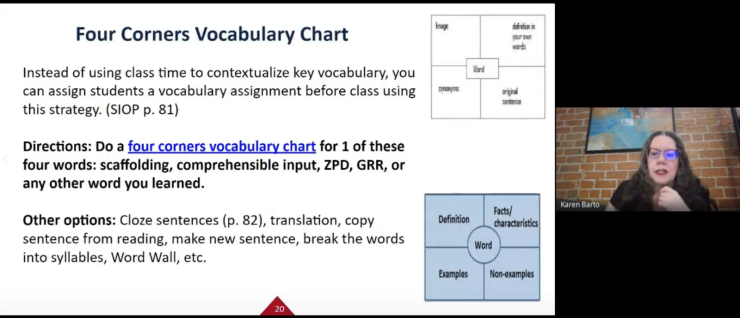
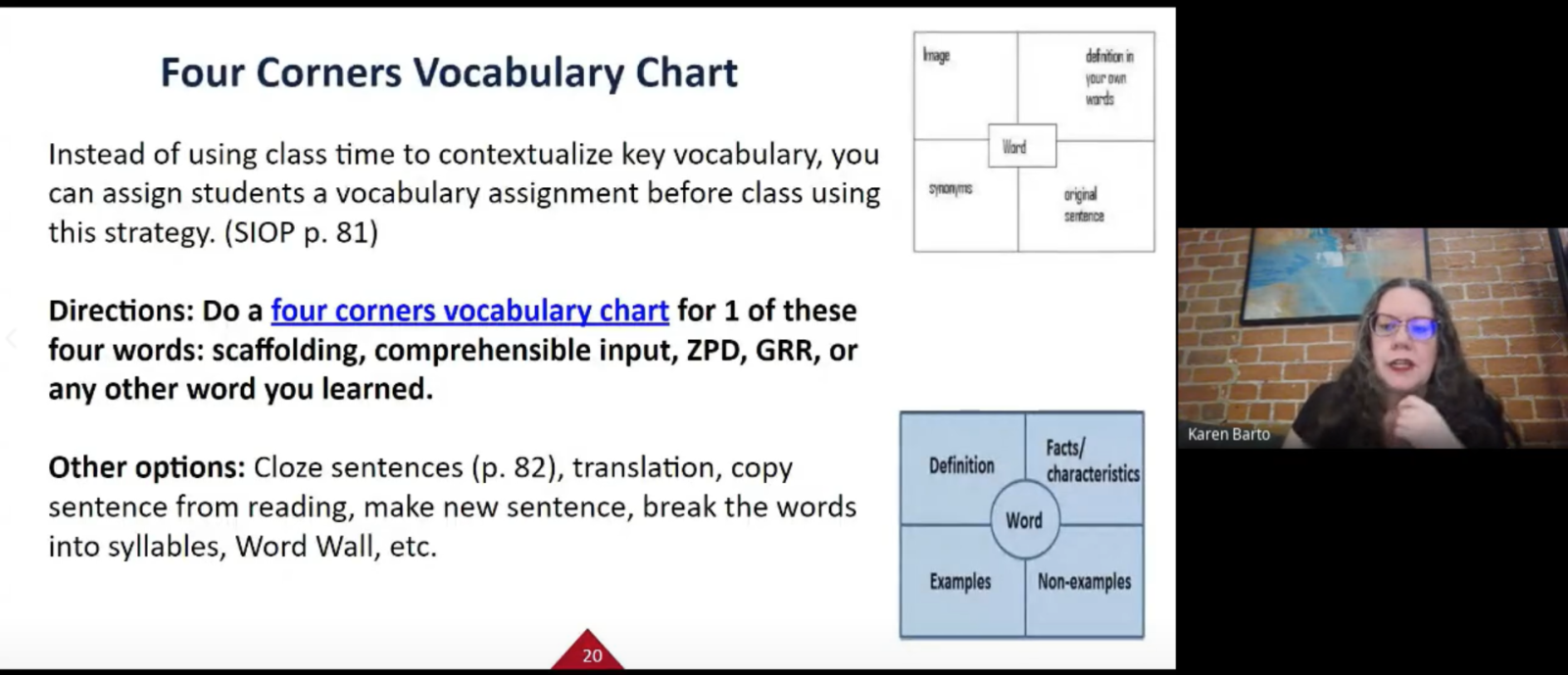
Graphic Organizer: Four Corners Vocabulary Chart
Graphic Organizer: Timeline
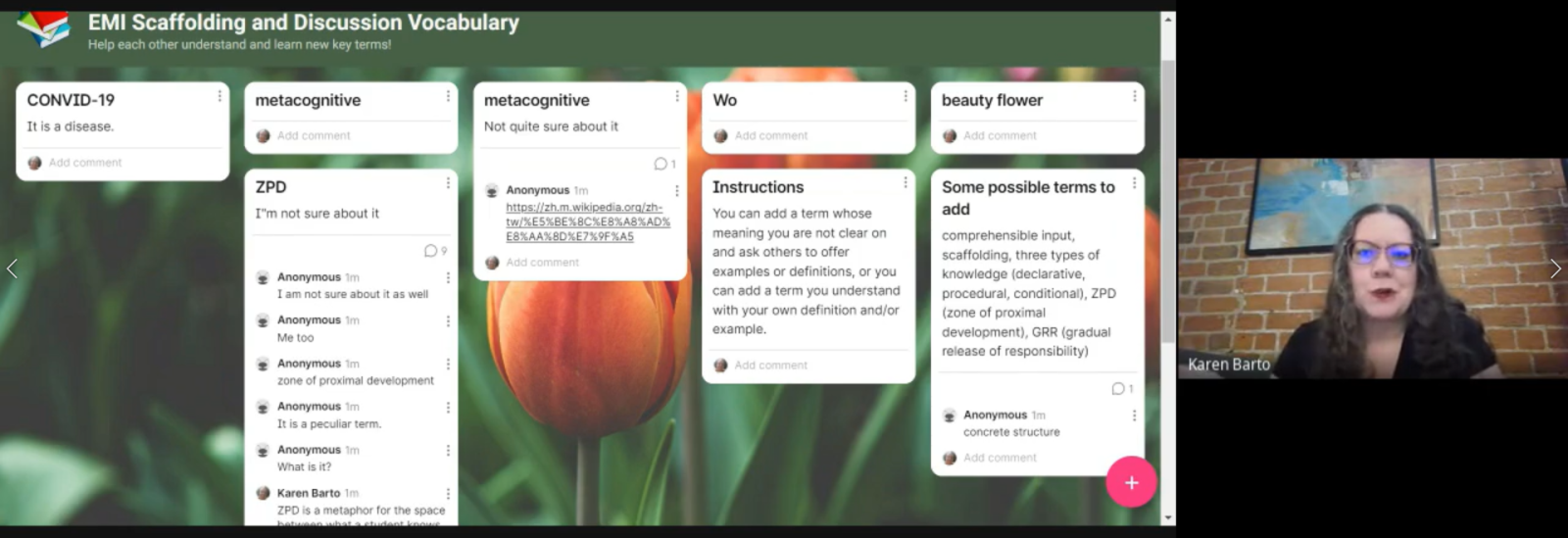
Graphic Organizer: Word Wall
Google Pronunciation
#AIT #ELS #EMI